Quinn Berger · 1 November 2026
Examining how custom etching techniques on borosilicate containers help maintain sample integrity during extended cryogenic storage in university labs
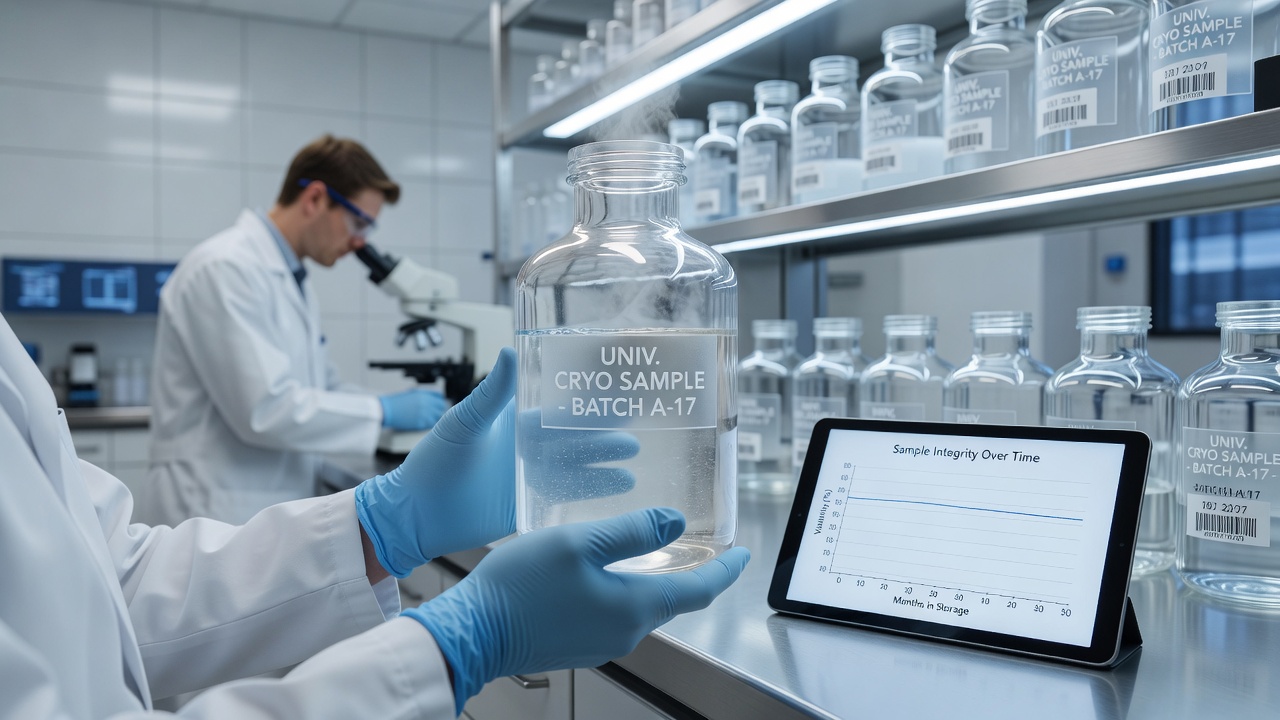
Custom etching techniques applied to borosilicate containers provide permanent identification methods that support sample tracking without introducing external materials that could compromise seals or surfaces during repeated freeze-thaw cycles, and university laboratories rely on these approaches to preserve both the physical condition and the documented history of specimens held at temperatures near -196 degrees Celsius for months or years at a time.
Properties of Borosilicate Glass Under Cryogenic Conditions
Borosilicate glass exhibits a low coefficient of thermal expansion which allows containers to withstand rapid temperature shifts between room conditions and liquid nitrogen storage without developing cracks or leaks, while the material also resists chemical attack from common cryoprotectants such as dimethyl sulfoxide and glycerol. Researchers at institutions conducting long-term biobanking note that these inherent characteristics reduce breakage rates compared with soda-lime glass alternatives, and the smooth surface finish typical of borosilicate further minimizes sites where ice crystals or contaminants might adhere during storage.
Custom Etching Methods and Their Application
Laser etching and controlled acid etching represent the primary techniques used to create durable markings on borosilicate vials and ampoules, with laser systems delivering precise depth control measured in micrometers so that structural integrity remains intact even after thousands of hours at cryogenic temperatures. Operators adjust beam parameters to produce alphanumeric codes, barcodes, or data matrix symbols directly into the glass surface, eliminating the need for adhesive labels that can detach or degrade when exposed to moisture and extreme cold. Studies conducted at multiple university facilities indicate that etched identifiers maintain readability after five or more years in vapor-phase nitrogen freezers, whereas printed labels frequently require replacement or lead to transcription errors during retrieval.
Impact on Sample Integrity and Traceability
Sample integrity encompasses both the biological viability of stored materials and the accuracy of associated metadata, and custom etching contributes to both aspects by providing tamper-evident markings that survive handling with forceps or automated retrieval systems. When containers carry permanent unique identifiers, laboratory staff can link each specimen to its electronic record without opening the vessel, thereby lowering the risk of contamination or warming events that occur during manual inspection. Data from biobanking networks show that misidentification incidents drop significantly when etched containers replace those relying on temporary tags, and this reduction supports reproducibility standards required for publication in peer-reviewed journals.
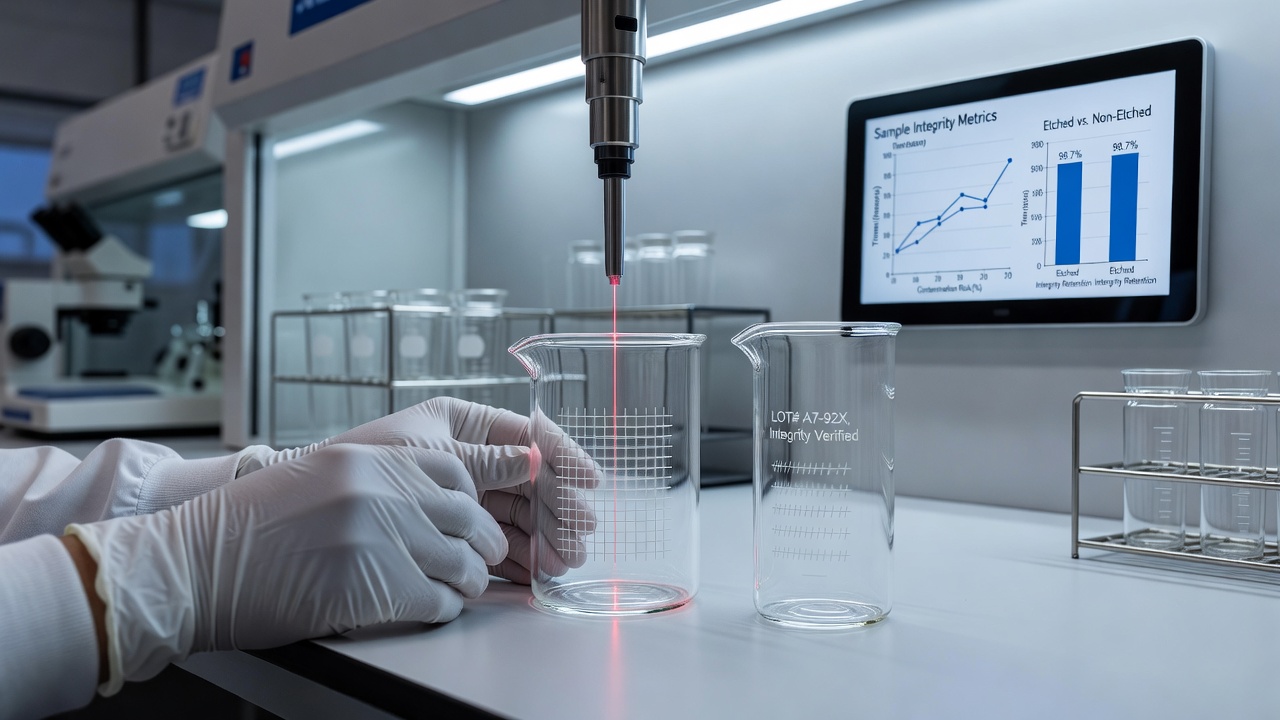
Etching depth and placement receive careful calibration because excessive material removal can create stress concentrations that propagate under thermal cycling, yet modern laser systems incorporate real-time monitoring to keep ablation within safe limits established by glass manufacturers. University procurement records reveal increasing adoption of pre-etched borosilicate containers supplied with standardized marking patterns that align with laboratory information management software, allowing seamless integration into existing workflows without additional equipment purchases.
Operational Practices in University Settings
Many university core facilities schedule regular audits of cryogenic inventories during which staff verify etched markings against database entries, and this process occurs without removing containers from their storage racks when two-dimensional codes remain visible through the frost layer. Training programs emphasize proper orientation of vials during initial placement so that etched surfaces face outward for quick scanning, and these protocols reduce the time each sample spends outside the freezer. As of November 2026, several North American and European institutions continue to expand their use of etched borosilicate systems in response to updated guidelines on sample provenance issued by international research consortia.
One research group at a Canadian university documented a 40 percent decrease in sample discard rates after switching to laser-etched containers, attributing the improvement to fewer instances of unreadable labels and subsequent handling errors. Similar observations appear in reports from Australian and Japanese laboratories that adopted comparable techniques for stem cell and genomic material archives, confirming that the approach scales across different regulatory environments and equipment configurations.
Conclusion
Custom etching on borosilicate containers supplies a reliable identification layer that integrates with the thermal and chemical demands of prolonged cryogenic storage, and university laboratories apply these techniques to sustain both physical sample quality and data accuracy over extended periods. Continued refinement of laser parameters and surface treatments supports broader implementation as storage volumes grow and traceability requirements become more stringent across global research networks.