Elena Friedrich · 18 October 2026
Tracing the Supply Routes of Precision Glassware from European Manufacturers to North American Research Labs
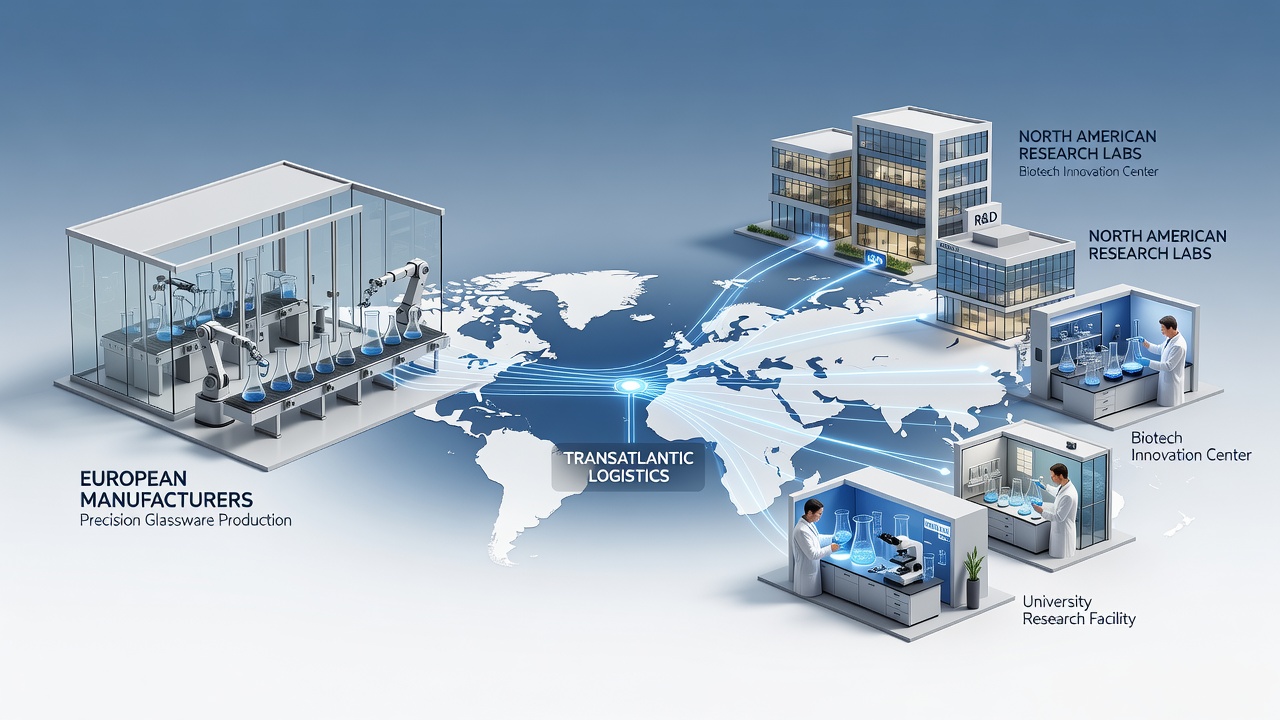
Precision glassware moves from specialized European production centers to research facilities across North America through established logistics corridors that combine manufacturing clusters, port networks, and inland distribution systems. European facilities in Germany, the Czech Republic, and France produce items such as volumetric flasks, pipettes, and chromatography vials that meet strict tolerances required by laboratories conducting chemical analysis and pharmaceutical testing.
European Production Centers and Output Patterns
Manufacturing sites located near the Rhine River and in Bohemia concentrate on borosilicate glass formulations that resist thermal shock and chemical corrosion. These plants operate continuous furnaces that feed automated forming lines, and production volumes have remained steady even as energy costs fluctuated during 2025. Data from the European Commission trade statistics show consistent export volumes of laboratory glassware destined for overseas markets, with October 2026 marking the scheduled rollout of updated harmonized tariff codes that affect documentation for certain specialty items.
Quality control protocols at these facilities include dimensional checks and thermal stress testing before items receive certification marks recognized by North American buyers. Batches travel in protective packaging that prevents breakage during multi-modal transit, and traceability systems record each lot number from furnace to final shipment.
Primary Shipping Corridors and Port Handling
Container vessels depart from Rotterdam and Hamburg carrying consolidated loads that include both finished glassware and raw materials for further processing. These routes cross the Atlantic in roughly twelve to fourteen days under normal weather conditions, after which cargo arrives at East Coast terminals such as Newark and Baltimore. West Coast shipments often originate from Mediterranean ports and reach Los Angeles or Vancouver after transiting the Panama Canal, a path that accounts for roughly one-third of total volume according to port authority records.
Air freight supplements ocean transport for urgent orders or low-volume custom pieces, though higher costs limit this option to time-sensitive research projects. Freight forwarders coordinate temperature-controlled containers when required, and electronic tracking platforms provide real-time updates to both shippers and receiving laboratories.

Customs Clearance and Regulatory Compliance Steps
Upon arrival, shipments undergo inspection by customs authorities that verify compliance with import regulations covering material composition and country-of-origin labeling. Canadian border services apply similar procedures at major gateways such as Montreal and Toronto, where documentation must align with Health Canada guidelines for laboratory equipment. Research indicates that most delays stem from incomplete certificates rather than physical inspections, prompting forwarders to pre-clear paperwork through digital portals.
Tariff classifications follow the Harmonized System, and duty rates for borosilicate laboratory ware have stayed within predictable ranges across recent fiscal years. October 2026 will introduce revised product descriptions that some importers are already incorporating into their compliance software to avoid future holds.
Inland Distribution Networks Serving Research Institutions
Once cleared, containers move by rail or truck to regional warehouses operated by scientific supply companies. These facilities break bulk shipments into smaller orders that reach university laboratories, contract research organizations, and government testing centers. Major hubs in Chicago, Houston, and Boston maintain inventories that allow next-day delivery for high-demand items, while specialized pieces ship directly from European stock when North American reserves run low.
Inventory management software integrates with laboratory procurement systems so that stock levels trigger automatic replenishment orders. Observers note that this integration reduces lead times compared with earlier manual processes, particularly for institutions running high-throughput analytical programs.
Conclusion
The supply routes that connect European glass manufacturers with North American research labs rely on coordinated manufacturing, maritime transport, customs processing, and regional warehousing. Updated tariff frameworks scheduled for October 2026 will require continued adjustments in documentation practices, yet the underlying infrastructure remains stable. Trade statistics compiled by the European Commission and import records maintained by Statistics Canada provide ongoing visibility into volume trends and route utilization, allowing stakeholders to monitor shifts in these established pathways.